
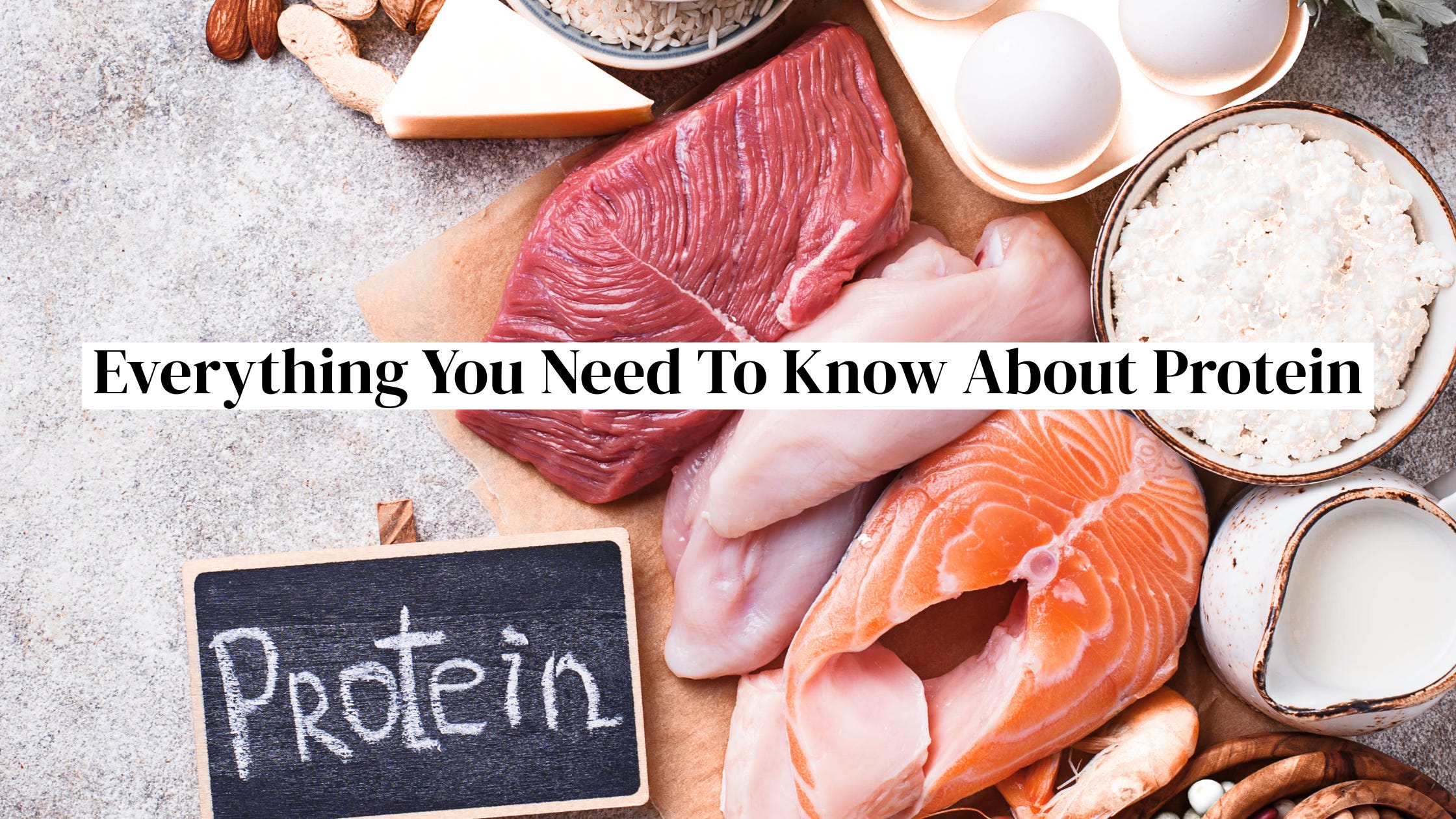
Everything You Need to Know About Protein
A Deep Dive Into the Science

This is the full evidence breakdown behind the practical protein guide on the blog. If you want the short version with the actual recommendations, start there and come back here when you want to know why the numbers are what they are.
Summary
Protein is a macronutrient built from amino acids, essential for muscle repair, immune function, and enzyme activity. Resistance training is the primary driver of muscle protein synthesis (MPS); dietary protein, especially leucine, supplies the substrate and the signal. For most people pursuing hypertrophy, ~0.7–1.0 g/lb body weight/day (1.6–2.2 g/kg) is a reasonable target, but the research behind specific numbers above ~1.6 g/kg is more contested than fitness content typically lets on, and that’s worth understanding rather than papering over. Plant-based eaters can build muscle comparably to omnivores at matched protein intake, though the evidence base here is smaller and mixed across outcomes, not uniformly favorable.
The basics
Protein is a polymer of amino acids linked by peptide bonds, basically, a long chain of smaller building blocks snapped together. There are 20 amino acids used to build human proteins. Nine are essential, meaning your body can’t make them and you have to get them from food. The other eleven are non-essential, meaning your body can make them itself, though a few of those become “conditionally essential” during illness or heavy physical stress, when your body’s demand outpaces what it can produce on its own.
Proteins do a lot of jobs beyond muscle building: they act as enzymes, transport molecules, antibodies, and gene-expression regulators. For training purposes, what matters most is the structural role, i.e., protein is the raw material your body uses to repair and build muscle.
A complete protein has all nine essential amino acids in good proportions. Most animal sources qualify, along with some plant sources like soy. An incomplete protein is short on one or more. Eating a variety of plant foods across the day still covers your full amino acid needs, so vegetarians and vegans don’t need to carefully pair foods at every single meal to get “complete” protein.
Dietary protein gets broken down into amino acids and small peptides in your stomach and small intestine, then absorbed and sent to your cells. Animal protein is generally more bioavailable than plant protein, meaning more of what you eat actually gets absorbed and used. But “generally” is doing real work in that sentence because the size of the gap depends heavily on which plant source you mean. More on that below.
Muscle protein synthesis (MPS)
MPS is the process of building new muscle protein: transcription, translation, incorporation into muscle fibers. The primary trigger is mechanical tension from resistance training. Dietary protein, and leucine specifically, supplies amino acids and activates the mTOR signaling pathway that initiates the anabolic response.
Leucine functions as a threshold signal, meaning a meal needs enough leucine to maximally trigger MPS, and in older adults the evidence supports a practical target of roughly 3–4 g per meal to overcome the anabolic resistance that comes with age. For younger adults, the picture is less tidy. Mechanistic research has suggested a threshold around 2.5 g, but a recent systematic review found no consistent dose-response relationship between leucine intake and MPS in younger adults, which means the “2.5 g” figure is better treated as a heuristic than a settled cutoff. As with the other acute evidence in this section, MPS response doesn’t always track 1:1 with long-term hypertrophy outcomes which is a distinction worth holding onto, since a lot of protein-timing advice quietly assumes it does.
Optimal MPS also requires adequate total energy intake. Chronic caloric deficit blunts MPS regardless of protein intake, which is why “eat more protein” isn’t a substitute for adequate calories during a cut.
How much protein, and why this number is more contested than it looks
The figure you’ll see everywhere, “1.6 to 2.2 g/kg/day,” comes mostly from one paper: Morton et al. (2018), a meta-analysis and meta-regression of 49 studies. It’s worth understanding what that paper actually found and how it found it, because it’s more equivocal than the soundbite suggests.
Where the 1.62 g/kg figure comes from — and why it’s weaker than it looks
Think of the breakpoint analysis as trying to find the plateau in a curve. Morton’s team asked whether a two-segment line (rises, then flattens) fit the data better than a single straight line. Using 42 study arms with 723 participants whose daily intakes ranged from 0.9 to 2.4 g/kg, they found the best-fitting bend point at 1.62 g/kg.
Two things to hold onto about that number. First, the regression itself didn’t reach conventional statistical significance, which means the two-segment model wasn’t clearly better than a simple straight line given the data they had. Second, the confidence interval is enormous: the true breakpoint could plausibly sit anywhere from about 1 g/kg to 2.2 g/kg. The authors were transparent about this, calling it an “unadjusted” estimate and recommending ~2.2 g/kg as a pragmatic upper bound precisely because the lower end of the interval might underserve many people.
What the more rigorous analyses in the same paper found
Separately from the breakpoint analysis, Morton et al. also ran meta-regressions, which are a more systematic way to ask whether any of four candidate variables (protein dose, baseline intake, age, training status) actually explained why some people gained more from protein supplementation than others. This is where things get interesting, because the same paper that produced the widely-cited 1.62 g/kg figure reaches a somewhat different conclusion pages later.
When each variable was tested on its own (univariate analyses), protein dose was the only one of the four that failed to significantly predict lean mass changes. The other three (baseline protein intake, age, and training status) did reach significance in the same tests. When all four variables were combined into a single model, the full model failed to explain the variance in lean mass gains or in strength gains.
The takeaway isn’t that protein intake doesn’t matter because the same paper’s main meta-analysis found that protein supplementation significantly improved both lean mass and strength. It’s that once you account for factors like age and training background, how much protein someone consumed above some baseline didn’t explain much of the variation in outcomes. Which is a more nuanced and useful thing to know than “the magic number is 1.62.”
Worth noting at a different evidentiary tier than the peer-reviewed papers cited throughout this piece: a widely circulated, non-peer-reviewed reanalysis by sports scientists Eric Trexler and Greg Nuckols (Stronger By Science) argues the 1.62 g/kg breakpoint is likely an artifact of the unadjusted model and that the true value, if one exists, is probably higher. They point to a cluster of studies where control-group intakes were already near 1.6–1.8 g/kg and further increases still produced gains. That argument is methodologically substantive and worth knowing about, but it hasn’t been through peer review, and it’s included here as informed commentary rather than as evidence carrying the same weight as the meta-analyses themselves.
Tagawa et al. (2021), a larger and methodologically different meta-analysis (105 studies, ~5,400 participants), used a flexible spline model rather than assuming a plateau exists. It found the dose-response relationship continued upward without a clean breakpoint, but the marginal benefit dropped sharply above ~1.3 g/kg/day: each additional 0.1 g/kg increment produced a 0.39 kg LBM increase below that point, versus only 0.12 kg above it. So “no plateau” is technically accurate but slightly oversells the practical story; this is diminishing returns, not a flat line.
Nunes et al. (2022) adds an important wrinkle neither of the above fully addresses: across 66 studies, additional protein ingestion produced only a small effect on lean body mass, and 80% of included studies had subjects already eating ≥1.2 g/kg/day at baseline. That’s a real confound: many “does more protein help” trials are testing the marginal effect of pushing already-adequate intake higher, not testing low-protein versus high-protein from scratch. However, this paper drew a published methodological critique. It is unclear whether the matter is still actively unresolved or not.
The Key Takeaway: there is no single clean number with strong, uncontested empirical support. What’s reasonably solid: more protein helps up to somewhere around 1.6 g/kg/day, with rapidly diminishing (not necessarily zero) returns beyond that, and individual variation is large enough that population-level breakpoints are blunt instruments. ~0.7–1.0 g/lb (1.6–2.2 g/kg) remains a sound practical target, not because any one study nails it down precisely, but because it sits within the range every major analysis treats as adequate-to-generous, and the cost of erring slightly high is low.
Protein needs run higher for experienced trainees and older adults, the latter due to anabolic resistance (a blunted MPS response per gram of protein, requiring a larger leucine dose to reach the same threshold). If you’re overweight, base your target on a reasonable goal weight rather than current weight, since protein needs track more closely with lean mass than total mass.
Distribution and timing
Total daily intake is a stronger predictor of outcomes than meal timing or distribution; this part holds up well across the literature. That said, distributing protein across 3–4 meals each containing roughly 20–40 g (enough to clear the leucine threshold) is a reasonable secondary strategy, since each meal you don’t clear the threshold is a missed MPS pulse, even if the daily total still adds up.
The “anabolic window,” the idea that protein must arrive within 30–60 minutes post-workout, is not well supported. The functional window is considerably wider, likely several hours, and matters most if you trained fasted. If you ate before training, the urgency of immediate post-workout protein is minimal.
Plant protein
This is the part that tends to get flattened into “good news, the gap basically doesn’t matter” or “bad news, plants can’t compete,” depending on which influencer is writing. Neither is quite right. Here’s what a careful read of the literature shows, broken down by outcome, because the studies below measure different things and conflating them is most of where the oversimplification comes from.
Digestibility and bioavailability are real but source-specific, not a flat percentage. DIAAS (digestible indispensable amino acid score) is the FAO-recommended standard for protein quality, calculated from ileal amino acid digestibility, usually measured in a pig model as a proxy for humans. A given food doesn’t have one fixed DIAAS: scores shift depending on which age-based reference pattern is used (infant, child, or adult), how the food was processed or cooked, and which study generated the underlying digestibility data, so figures for the same source can vary somewhat across the literature. With that caveat, a representative compiled dataset still shows wide and consistent separation by source: wheat around 43, brown rice around 60, oats around 66, pea around 73, soy protein isolate around 90, and potato protein over 100, in the range of many animal sources. A blanket claim like “plant protein absorbs at 60-80%” collapses sources that are nutritionally very different from one another. The accurate statement is that some plant proteins (wheat, oats, most other cereals) digest and complete meaningfully worse than animal protein, while soy and potato largely don’t, and the exact number for any one source should be treated as approximate rather than canonical.
Acute, single-meal MPS studies generally show animal protein producing a stronger response, attributable to leucine content and digestion rate. This is fairly consistent mechanistic evidence and isn’t seriously contested.
Longer-term hypertrophy trials are mixed, and the mix depends on which outcome you’re measuring. Four relevant analyses, in chronological order:
Monteyne et al. (2023), the most-cited single trial on this question, compared a high-protein mycoprotein-rich vegan diet against an omnivorous diet (both ~1.8–2.0 g/kg/day) over 10 weeks of resistance training. It found comparable myofibrillar protein synthesis and statistically similar lean mass gains (omnivorous group +2.6 ± 1.1 kg, vegan group +3.1 ± 2.5 kg; P > 0.05) and identical thigh muscle growth (8.3% in both groups). It’s a real result, but a small one (16 participants in the acute MPS phase, 22 in the training phase), and the vegan arm was built specifically around mycoprotein, which has an unusually favorable amino acid profile. It’s good evidence that a well-constructed, high-leucine plant diet can match an omnivorous one; it’s weaker evidence about plant protein broadly.
Lim et al. (2021), a systematic review and meta-analysis pooling 16 RCTs, found protein source didn’t significantly affect absolute lean mass overall or strength gains, but animal protein produced a statistically significant edge in percent lean mass overall, and younger adults specifically (under 50) gained more on both absolute and percent lean mass with animal protein. No difference was seen in adults 50 and older.
Reid-McCann et al. (2025) revisited the question with a different RCT set (43 trials) and explicitly critiqued Lim et al.’s methodology, noting that some included trials had substantial mismatches in the gram weight of plant versus animal protein interventions (up to 25.8 g difference in one trial) and used a looser age cutoff for “older adults.” Pooled across all plant sources, they found plant protein produced lower muscle mass than animal protein following intervention, with the effect concentrated in younger adults (<60) and not significant in older adults (≥60). But the source-level breakdown matters more than the pooled number: soy protein showed no difference from animal protein at all, while non-soy plant proteins (rice, chia, oat, potato) and whole plant-based diets did show a deficit. In other words, the entire “plant protein is inferior” effect in this analysis is being driven by non-soy sources and whole-diet comparisons; soy specifically held up fine.
López-Moreno et al. (2025), looking specifically at muscular strength rather than lean mass, found no significant difference between plant-based and omnivorous diets across upper-body, lower-body, and overall strength outcomes.
Read together, these aren’t a flat contradiction so much as a more granular picture than either “plants can compete” or “plants can’t” implies: any lean-mass deficit on plant protein looks concentrated in non-soy sources and whole plant-based diets, not in soy specifically, and concentrated in younger trainees more than older ones, while strength outcomes look comparable across diet types regardless of source. That’s a meaningfully different takeaway than “plant protein in general lags animal protein,” and it points toward a specific, actionable distinction rather than a vague hedge. “The gap is basically gone” and “plant protein can’t compete” are both overclaims, but so is “plant protein” as an undifferentiated category; the accurate position is source-specific.
What’s not contested: total daily protein intake is the dominant variable regardless of source, and the practical gap, where one exists, is narrow enough to address with modest adjustments:
Prioritize soy (unless you have a soy allergy) specifically (tofu, tempeh, edamame, soy protein isolate) over other plant proteins if you’re optimizing for lean mass: it’s the one plant source with direct evidence of performing on par with animal protein, not just “probably close enough.” Other higher-leucine sources (legumes blended with grains) are reasonable too, just with less direct head-to-head evidence behind them. Seitan (wheat gluten) is lysine-poor and digests less completely; pair it with legumes if it’s a primary source.
Eat somewhat more total protein than an equivalent omnivorous target as a buffer. Something like a 10% addition is a reasonable rule of thumb, not a hard, precisely evidence-pinned requirement.
Don’t rely on a single plant source per day. Blending (legume plus grain) covers limiting amino acids that any one source alone might miss.
On the broader point sometimes raised in these comparisons, that plant-forward diets carry cardiovascular and longevity advantages (lower LDL/ApoB, reduced inflammation), that’s a separate question from hypertrophy outcomes, well-supported in its own right, and not something this guide is trying to adjudicate. It’s a legitimate reason to prefer a plant-forward approach independent of how the muscle-building math shakes out, but it shouldn’t be used to inflate the strength of the muscle-building evidence itself. That’s a common rhetorical move worth naming and avoiding.
Key takeaways
Protein is essential for muscle repair, growth, immune function, and broad cellular function; nine amino acids must come from diet.
MPS is primarily triggered by mechanical tension from training; protein (especially leucine, ~2.5 g/meal threshold in younger adults) provides the necessary signal and substrate.
~0.7–1.0 g/lb (1.6–2.2 g/kg)/day is a defensible practical target, but treat any specific breakpoint figure (1.62 g/kg, “no plateau,” etc.) as contested rather than settled. The Morton et al. breakpoint analysis wasn’t itself statistically significant, its confidence interval spans 1.03–2.20 g/kg, and the more rigorous meta-regression analyses in the same paper found protein dose didn’t behave as a significant predictor of outcomes. Tagawa et al. found no clean plateau but sharply diminishing returns above ~1.3 g/kg. Nunes et al. suggests effect sizes may be smaller than commonly implied once baseline intake is accounted for.
Total daily intake predicts outcomes better than timing; 3–4 meals of 20–40 g each is a reasonable distribution strategy, not a requirement.
The “anabolic window” is hours wide, not 30–60 minutes, and matters most after fasted training.
Plant protein bioavailability varies hugely by source (DIAAS around 43 for wheat, around 90 for soy isolate, over 100 for potato, with exact values depending on reference pattern and processing); there is no single “plant protein absorption rate.”
Plant-based hypertrophy outcomes are genuinely mixed and outcome-dependent, but the picture sharpens once you separate sources: soy protein shows no measurable deficit against animal protein for lean mass, while non-soy plant proteins and whole plant-based diets show a modest one, concentrated in younger trainees. Strength outcomes look comparable across diet types regardless of source. Neither “no gap” nor “plants can’t compete” is well-supported as a blanket claim about plant protein generally; soy specifically performs about as well as animal protein.
Chronically low calorie intake blunts MPS regardless of protein intake.
Bibliography
Inca-Barriga, O., Alberti-Nuñez, P., & López-Moreno, M. (2025). Comment on “Systematic Review and Meta-Analysis of Protein Intake to Support Muscle Mass and Function in Healthy Adults” by Nunes et al. Journal of Cachexia, Sarcopenia and Muscle, 16(4), e70036. https://doi.org/10.1002/jcsm.70036
Lim, M. T., Pan, B. J., Toh, D. W. K., Sutanto, C. N., & Kim, J. E. (2021). Animal protein versus plant protein in supporting lean mass and muscle strength: A systematic review and meta-analysis of randomized controlled trials. Nutrients, 13(2), 661. https://doi.org/10.3390/nu13020661
López-Moreno, M., Rossi, E. V., López-Gil, J. F., Marrero-Fernández, P., Roldán-Ruiz, A., & Bertotti, G. (2025). Are plant-based diets detrimental to muscular strength? A systematic review and meta-analysis of randomized controlled trials. Sports Medicine — Open, 11(1), 62. https://doi.org/10.1186/s40798-025-00852-7
Monteyne, A. J., Coelho, M. O. C., Murton, A. J., Abdelrahman, D. R., Blackwell, J. R., Koscien, C. P., Knapp, K. M., Fulford, J., Perkins, J. D., Massey, G. J., Stephens, F. B., Dirks, M. L., & Wall, B. T. (2023). Vegan and omnivorous high protein diets support comparable daily myofibrillar protein synthesis rates and skeletal muscle hypertrophy in young adults. The Journal of Nutrition, 153(6), 1680–1695. https://doi.org/10.1016/j.tjnut.2023.02.023
Morton, R. W., Murphy, K. T., McKellar, S. R., Schoenfeld, B. J., Henselmans, M., Helms, E., Aragon, A. A., Devries, M. C., Banfield, L., Krieger, J. W., & Phillips, S. M. (2018). A systematic review, meta-analysis and meta-regression of the effect of protein supplementation on resistance training-induced gains in muscle mass and strength in healthy adults. British Journal of Sports Medicine, 52(6), 376–384. https://doi.org/10.1136/bjsports-2017-097608
Nunes, E. A., Colenso-Semple, L., McKellar, S. R., Yau, T., Ali, M. U., Fitzpatrick-Lewis, D., Sherifali, D., Gaudichon, C., Tomé, D., Atherton, P. J., Robles, M. C., Naranjo-Modad, S., Braun, M., Landi, F., & Phillips, S. M. (2022). Systematic review and meta-analysis of protein intake to support muscle mass and function in healthy adults. Journal of Cachexia, Sarcopenia and Muscle, 13(2), 795–810. https://doi.org/10.1002/jcsm.12922
Reid-McCann, R. J., Brennan, S. F., Ward, N. A., Logan, D., McKinley, M. C., & McEvoy, C. T. (2025). Effect of plant versus animal protein on muscle mass, strength, physical performance, and sarcopenia: A systematic review and meta-analysis of randomized controlled trials. Nutrition Reviews, 83(7), e1581–e1603. https://doi.org/10.1093/nutrit/nuae200
Stronger By Science (Trexler, E., & Nuckols, G.). Protein Science Updated: Why It’s Time to Move Beyond the “1.6-2.2g/kg” Rule. Retrieved June 2026, from https://www.strongerbyscience.com/protein-science/ (Non-peer-reviewed analysis by sports scientists; included as informed commentary on the Morton et al. data, not as evidence of equivalent weight to the peer-reviewed sources above.)
Tagawa, R., Watanabe, D., Ito, K., Ueda, K., Nakayama, K., Sanbongi, C., & Miyachi, M. (2021). Dose-response relationship between protein intake and muscle mass increase: A systematic review and meta-analysis of randomized controlled trials. Nutrition Reviews, 79(1), 66–75. https://doi.org/10.1093/nutrit/nuaa104
Zeng, Y., Chen, E., Zhang, X., Li, D., Wang, Q., & Sun, Y. (2022). Nutritional value and physicochemical characteristics of alternative protein for meat and dairy: A review. Foods, 11(21), 3326. https://doi.org/10.3390/foods11213326 (Cited for its compiled DIAAS table, Table 2, which draws on multiple primary ileal-digestibility studies; this is a secondary source for those figures, not the original data.)